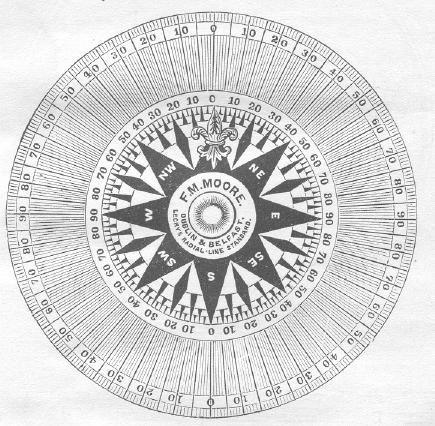
Magnetic compass divided into four 90 deg sections
from - Wrinkles in Navigation - Lecky, S.T.
19th edition
page 16
click on image above to
see larger version.
A direction description on this compass might be given as " S 79 W "
which would be equivalent to 259 degrees on the modern compass. (See wording
on 19th ed. of Lecky, page 30.) From the previous example one might assume
that 150 degrees on the new compass card would equal " S. 30 E. ".
When Lecky discusses steering courses on pages 33 and 34 his directions use
the more ancient points system for the helmsman to follow, such as " W.
by S. one half S. ". Note: the 19th edition was published some 17 years
after Lecky died, and was revised and enlarged by William Allingham.
A fascimile reprint of Lecky's first (1881) edition of Wrinkles in
Navigation is available
Elibron (elibron.com) and various editions of Wrinkles are
available in the used book trade - always check for edition - there are many
different editions, both English and American. I doubt that the editions
that came out in the 1940 s have the same information and flavor as the
earlier editions.
A more modern compass card.
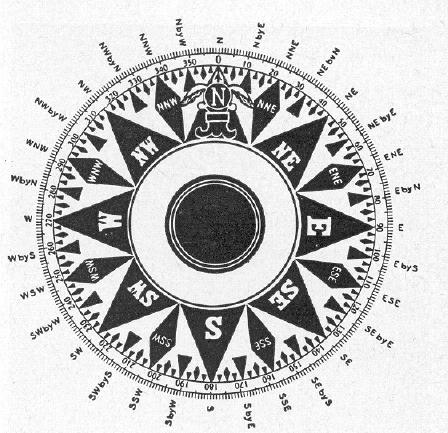
note the 4 cardinal points are at
0 deg = North
90 deg = East
180 deg = South
270 deg = West
An early example from the mid part of the 1700's uses this 90 degree
system. The collection of the Royal Observatory has this example, a compass signed as
made by William Farmer circa 1750 which shows this 90 degree system on the
outer ring, with a 32 point compass rose in the middle.
see their article in the National Maritime Museum, UK .
(It should be
noted this practice was not imediately universally adopted and that
compass cards made later than 1750 often used only the points system,
dividing the compass into 32, 64 and 128 divisions.)
The British Royal Navy used this 90 degree system as its standard for a number of
years.
From Bowditch - American Practical Navigator - 1962 edtion - noted on page 137.
"An older system still used somewhat is to graduate the card through
90 degrees in which each quadrant, increasing from both north and
south."
From Bowditch - American Practical Navigator - 1938 edtion - noted on page
28.
"The circular card of the compass is divided on in's periphery into 360
degrees. For sailing ships, it is sometimes numbered from 0 degrees at North
and South to 90 degrees East and West .... "
Note that both the 9th edition (1909) and 11th edition (1911) of
Encyclopedia Britannica show the 90 degree compass as the standard
mariner's compass.
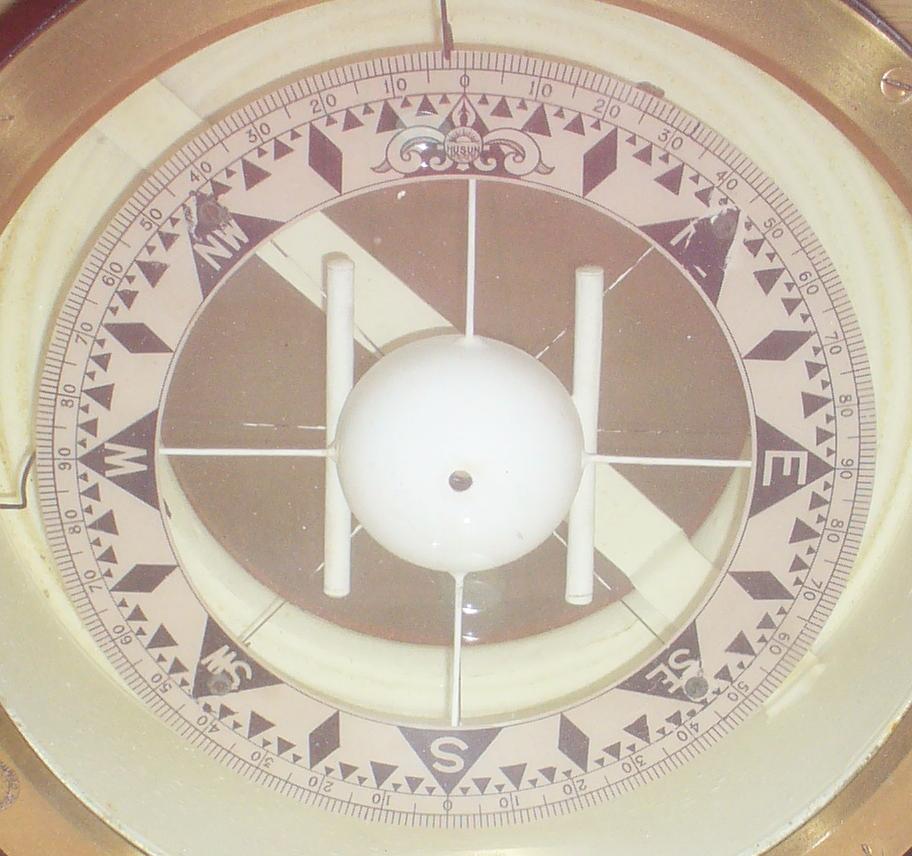
An actual compass which is marked in the 0-90 standard.
This example exists in the Maritime Museum in Victoria, BC, Canada.
Note the very finely divided graduations of the old points system on this compass card.
There are 32 measurements in 90 degrees... 128 in the whole circle.
This was made by HUSUN which was the H. Hughes and Son Company of London.
The firm begun by Henry Hughes in the 1830s became H. Hughes & Son in 1875, and H. Hughes & Son, Ltd. in 1903.
After a merger with Kelvin, Bottomley & Baird, Ltd. in 1947, it became Kelvin & Hughes, Ltd. The "HUSUN" trademark was in use by the 1920s.
Ref: Gloria Clifton, Directory of British Scientific Instrument Makers 1550-1851 (London, 1995), p. 144.
The Smithsonian in Washington, DC has a
HUSUN Compass 360 degrees which is the more modern measuring system.
History of Compass page.
Return to the Nav index page.
-- update 3 May 2006