CHAPTER
- 21 -
Awahnee Means Peace
CHAPTER
- 21 -
Awahnee Means Peace
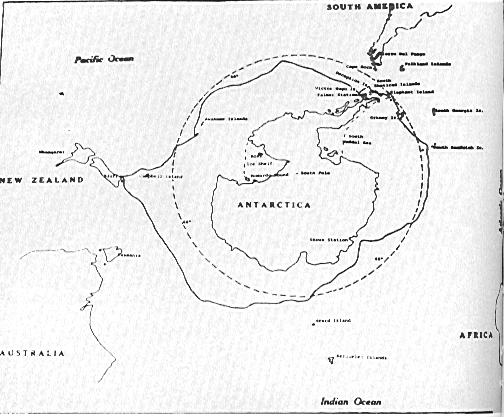
The circumference of the earth at 60 deg south
latitude is half what it is at the equator; our
projected course from New Zealand to New
Zealand was 12,000 miles. We hoped to sail it
in 100 days. We took aboard enough stores to
winter over in Antarctica, 16 months supply, in
case some accident or failure befell Awahnee.(1)
AT 0400 HOURS ON DECEMBER 22, 1970, A LONG SLEEK,
seawise cutter moved out from Bluff on the southern tip of South
Island, New Zealand, with the wind west by south, and ran across
Foveaux Strait under storm jib and double-reefed main. A call was
made at Stewart Island, then after final preparations and last-minute
letter writing and a good dinner ashore, the yacht put to sea again at
2020 hours, just as darkness fell.
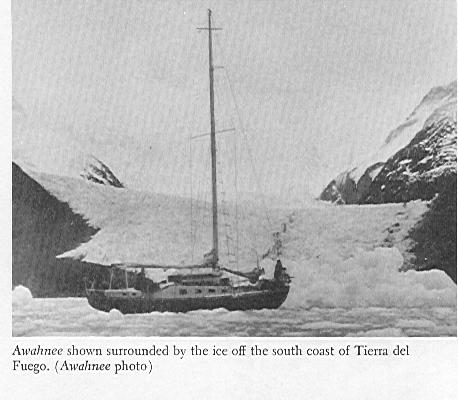
The yacht was the world-girdling Awahnee, the first ferro-cement
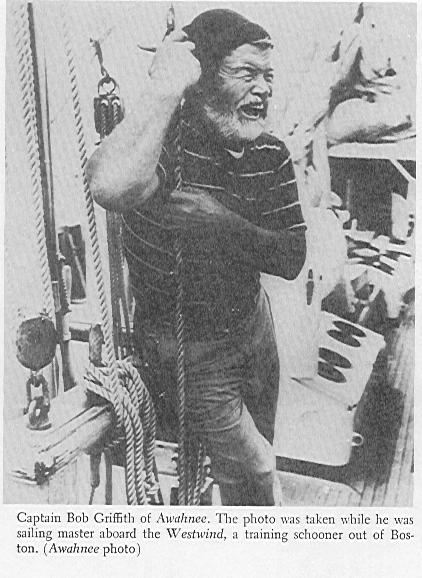
vessel to circumnavigate, now carrying her owners, Dr. Robert Lyle
Griffith, his wife, Nancy, and son, Reid, on their third circumnaviga-
tion of the world, this time on a track never before attempted by a
pleasure craft.(2)
Aboard on this voyage, as usual, the Griffiths had several crew
members, all stout New Zealanders who had volunteered Pat
Treston, an Auckland lawyer; Ash Loudon, a student at Otago; and
John O'Brien, an Auckland businessman.(3)
The yacht was actually Awahnee II the first one of that name,
~ 201 ~
designed by the famed Uffa Fox, and in which the Griffiths made
their first circumnavigation, was lost on a voyage in the French
Oceania area. Awahnee II II was built by the Griffiths in New Zealand
from the original plans but in the then experimental ferro-cement
mode, in which New Zealand has become a world leader. Awahnee
II, like the original, was 53 feet overall, with a 42-foot waterline, a
beam of 12 feet, and a draft of 7 feet 6 inches. Loaded, she displaced
25 tons. A 22-horsepower Yanmar three-cylinder diesel provided
auxiliary power.
For the Antarctic circumnavigation, the ship had bcen completely
reconditioned and modified. The hull and decks had been sand-
blasted to bare concrete and then fiberglassed with cloth and resin.
The interior was lined with Styrofoam to insulate and prevent
condensation. A sixty-foot exhaust pipe was fitted from the engine
forward through the two cabins on the port side under the berths,
then aft again to come out behind the cockpit. This dry exhaust, the
first ever installed that was longer than the boat it was installed in,
provided heat in the cold latitudes. In addition, a closed-circuit
engine-cooling system was devised from two drums that didn't work
which became apparent before they left Whangarei harbor.
Aboard the double-ender was a year's supply of groceries in case
they became ice-bound or otherwise incapacitated and had to wait
out an Antarctic winter, as had many explorers of old when they
found themselves frozen in the ice pack for a year.
Departing Bluff, the Griffiths and their crew of New Zealanders
headed southeast in the general direction of the Ross Sea, roughly
following the course of Captain James Cook, the first to circumnavi-
gate the Antarctic and whose 205-year-old journal was kept aboard
and read aloud by Nancy as they followed his track. Passing Auckland
Island, the first port of call was the remote and lonely station on
Campbell Island, a New Zealand weather-reporting installation,
where they celebrated Christmas with the crews at the station and
from the U.S. icebreaker Staten Island.
Heading south through the Furious Fifties and into the Shrieking
Sixties, they encountered monstrous waves and gale winds, and their
first sign of ice, which required a constant lookout day and night. On
New Year's Day midsummer there the temperature was 32°. Four
days out of Campbell Island, they lost a headstay and repairs were
made by agile Reid. At 63°S, they were trapped by ice and had to
backtrack for 40 miles. On the tenth day, at 61°S and 159°W, they
sighted three islands where no land was shown on the charts.(4)
~ 202 ~
Sailing among tall icebergs, some 200 feet in height, they got their
first look at the Antarctic continent at 66°S as they passed about 600
miles south of Cape Horn. At Palmer Station,5 they were received
with astonishment by the U.S. and British scientists. They were now
a third of the way around the world at this latitude.(6)
From here on, they visited nine scientific stations U.S., Argen-
tine, British, Russian, and Chilean and two whaling stations, now
defunct. On Deception Island, they anchored in a submerged crater,
where there is now a 900-foot-high island.
At the U.S.S.R.'s Bellinghausen Base, they learned from the doctor
there that Nancy was pregnant. They tried to land a plaque from the
New Zealand Shacketon Sea Scouts on Elephant Island, but could
not get ashore. This was the survival camp of the ship Endurance,
which was crushed in the ice in 1914. At Signey Island in the South
Orkneys, they survived the British conviviality. From the Argentine
base Orcades, they departed for New Zealand with a drum of fuel
and a generous food supply given them by the men, who were already
short since the annual supply ship had not arrived.
Fearing a disastrous holing of the hull by growlers and floating
chunks of ice, they sailed usually with a drogue out on rough nights
to steady the yacht, sometimes making 6 knots under a 48-foot storm
staysail alone. They came into the Indian Ocean about 1,600 miles
from Africa, and three days later crossed the Antarctic Circle. Fresh
water was obtained by melting ice from the last berg encountered on
a calm day. As they crossed under Australia, they were struck by a
staggering blow which sent green water over Awahnee again and
again. The final run to Stewart Island and Bluff was made in brilliant
sunshine and light winds.
The circumnavigation had taken 111 days (the fastest on record),
84 of which were sailing days and 27 of which were in port or partial
sailing days. Nancy left to rejoin their baby son, Tenoi'i, in
Whangarei, a thousand miles north. Bob and the crew sailed
Awahnee up the coast, on the way being struck by lightning and
dismasted only 60 miles from home port. It was a climactic end to
their third voyage around the world.
Born in January 1917, Griffith grew up to be a prosperous and
successful veterinarian and cattle rancher in Tomales Bay, California,
about sixty miles north of San Francisco. In middle age, he found
himself on a treadmill, headed for a cardiac or ulcers, and decided it
was time to broaden life a little. Searching the waterfront brokerages
and yacht clubs, he found the original Awahnee, which had been
~ 203 ~
built by an Englishman for use as a family yacht. Griffith and his
wife made a shakedown cruise up the California coast, and then they
set out on the first voyage, a scientific expedition to the Marquesas.
After this came other charter trips around the Pacific, then they
settled down in New Zealand.
After some time ashore, the Griffiths took off again, on their first
circumnavigation, west-about across the Indian Ocean, with a crew of
five in a fast passage until the Red Sea was reached. There they ran
up on a reef and were impaled. At least 250 ships passed by refusing
to answer their distress signals. Going ashore, Griffith became em-
broiled in local politics and red tape. He went back to the vessel with
some dynamite and literally blew Awahnee free, immediately running
the yacht ashore before she filled with water. They beached safely
and made repairs, then went on into the Mediterranean, where they
cruised for months. Passing out through the Strait of Gibraltar, they
encountered the worst gale of the voyage, with winds recorded to
138 knots.
Their first Atlantic crossing, however, was made in the fast time of
eleven days in perfect sailing weather. Then they went down through
the Panama Canal and into the Pacific to complete their first circum-
navigation.
After a few months of leisurely cruising, they went in search of a
missing American yacht after first being arrested as gun-runners and
forced to clear their record of the charge by the French police. They
did not find the missing yacht, but did find three others that were
wrecked and unreported. Then Awahnee was carried onto a reef and
wrecked. The Griffiths spent a week salvaging everything they could,
including rigging, masts, machinery, and food before she broke up.
The family had then been to sea for four years.
At first, they thought the island was uninhabited, but then found
two natives gathering copra. One of them, Teka, later became a long-
time member of their crew. After sixty-seven days, they got word to
French authorities and were rescued. The rescue was typically Gallic.
A gendarme waded ashore, decked out in his finest uniform, and was
met by Dr. Griffith in tattered clothes and beard. The gendarme
extended his hand.
"Dr. Griffith, I presume?"
They were taken to Tahiti under guard and accused of being
atomic spies. Later cleared, they bought another boat, an ancient
English ketch, and sailed to New Zealand. There they found the
~ 204 ~
ferro-cement business going strong. Redesigning Awahnee, they trav-
eled over the country looking at boats under construction. Some were
so bad that the owners merely dug a hole and bulldozed the hulls
into it. But the Griffiths decided this was it. They spent five months
building, and another in outfitting Awahnee II. The work was done
at Auckland and attracted much attention. The ribs were 3/4-inch
water pipe welded in place. Two miles of steel wire was stretched
between the ribs, and eight layers of chicken wire stretched over the
whole frame (the entire supply available in the city). This was then
plastered with a cement mixture in a continuous operation. The shell
had an average thickness of 7/8 inch. After launching, she weighed
fourteen tons, which went down to twenty-three tons when fully
loaded, about ten percent lighter than the original wooden vessel.
After a shakedown, the Griffiths departed on their second circum-
navigation. Five days out of Russell, Awahnee was punching through
40-foot seas and hurricane winds, and twice was knocked down. In
subfreezing weather, they rounded Cape Horn where the anchor
froze to the deck and ice hung from the rigging.
On a passage from Peru to the Marquesas, a 4,000-mile run, they
took only 25 days from the fuel barge at Callao on September 1966 to
Taa Huku Bay on the evening of October 13. Fast passages were a
trademark with the Griffiths. Usually, they carried a crew of volun-
teers and, as Dr. Griffith remarked later, out of two hundred extra
crew members shipped, all but three would be welcome back.
Reid, the Griffith son who began sailing at age five, grew up at sea
where he learned to cook, to work a noon sight, to hand, reef, and
steer with the best bluewater sailors. Nancy Griffith, also, became an
expert sailor and navigator, and on at least one voyage (to Hawaii)
skippered the ship with a crew of amateurs while her husband was
away on business. On one passage, Nancy was almost lost. Thrown
overboard by a freak jibe of the mainsail, she was in the shark-
infested waters of the Indian Ocean for a half hour before she could
be spotted, the vessel turned around, and a rescue made.(7)
During the second circumnavigation, Awahnee sailed up for Japan
and clockwise down around the Aleutians, the Gulf of Alaska, and
back to California. At this time, the Griffiths had been at sea for
eight years and covered 150,000 sea miles. In San Francisco, the
family found the freeway traffic and the crowds more terrifying than
anything encountered at sea.
After further adventures in the Pacific, the Griffiths came back to
~ 205 ~
California, settling for a time at Inverness, where Bob became
involved with a nonprofit enterprise to turn the 100-foot schooner
Westwind into a training ship for boys.
At the annual dinner of the Cruising Club of America in New
York, January 25, 1973, Griffith was the featured speaker. Since 1959,
with his family, he had sailed 170,000 miles and made three circum-
navigations in two yachts. His was a most remarkable record, and for
it, he was awarded the prestigious Blue Water Medal for 1972. The
late John Parkinson, Jr., awards chairman, commented, "In all my
years of serving on this committee, in my opinion we have never had
a recipient so deserving of this honor."
The last passage Awahnee made prior to the award, was one of 19
days to Tahiti, then 19 days to Honolulu and 18 1/2 days to San
Francisco, arriving there in time for their daughter, Fiona Nikola
Antares, to be born in the United States. Reid attended summer
school, and later finished high school, while Dr. Bob holed up to
write a book on a farm in New England. When the book was done,
the babies were older, and Reid graduated from high school, the plan
was to cast off moorings at Tomales Bay and set sail again for what-
ever adventures remained.(8)
~ 206 ~
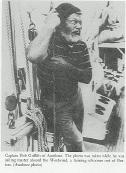
- end Chapter 21 -
=======================================================================
AUTHOR's NOTES
Chapter Twenty-one
1. From Awahnee Newsletter #14, in The Spray, Volume XVI, 1972.
2. Soon after the Griffiths' voyage, Dr. David Lewis, another well-
known circumnavigator, departed on an attempt to circle the globe at 60° S
nonstop and solo, on the small Icebird.
3. See also Sea Spray magazine published at Wellington, for June,
July, and August 1971.
4. The nearest charted land was the Nimrod Island group, three
hundred miles to the north. The U.S. Hydrographic Office reported the islands
were discovered in 1828 and not sighted again. In 195t, they were removed from
all charts as nonexistent. The Griffiths applied to have them named the Awahnee
Islands.
5. Named for the legendary Nathaniel Palmer, who, in his teens,
skippered a whaling supply vessel and purportedly was the first to discover or
actually sight the Antarctic continent.
6. See also National Geographic magazine, November 1971, Vol. 140, No. 5, pp. 635.
7. Man-overboard is one of the most harrowing things that can happen
to voyagers, and it happens all too frequently. Another notable incident was
when Beryl Smeeton was thrown into the sea as Tzu Hang pitchpoled near Cape
Horn.
8. In a letter from Bob Griffith, early in 1974, from Hawaii, he indicated
Awahnee was still alive and well after 13 years of world voyaging, making
frequent passages to and from the mainland.