A History of the USS CABOT (CVL-28):
A Fast Carrier in World War II
by J. Ed Hudson
.
U.S. Fast Carriers that saw action in the Pacific Theater, World War II
USS Lexington (CV 2) and USS Saratoga (CV 3) 36,000 tons, 34 knots
("Lady Lex" was sunk in the Coral Sea Battle)
USS Yorktown (CV 5) and USS Enterprise (CV 6) 19,800 tons, 34 knots
(Yorktown was sunk in the Battle of Midway)
USS Wasp (CV 7) 14,700 tons, 30 knots
(Sunk in 1942 near Espiritu Santo)
USS Hornet (CV 8) 19,800 tons, 34 knots
(Sunk near Santa Cruz Islands)
Independence-type CVLs Nine in all, 11,000 tons, 31.6 knots
USS Princeton (CVL 23) sunk in 1944 off the Philippines)
Essex-type carriers 27,100 tons, 33 knots, short hull - 872 feet
Essex (CV 9)
Yorktown (CV 10)
Intrepid (CV 11)
Hornet (CV 12)
Franklin (CV 13)
Lexington (CV 16)
Bunker Hill (CV 17)
Wasp (CV 18)
Bennington (CV 20)
Bon Homme Richard (CV 31)
Essex-type carriers long hull - 888 feet
also called Ticonderoga class)
Ticonderoga (Cv 14)
Randolph (CV 15)
Hancock (CV 19)
Shangri-La (CV 38)
No Essex-type carriers were lost to the enemy,
but two were severely damaged and put out of action -
Franklin and Bunker Hill.
~ 161 ~
INDEPENDENCE CLASS CVLs
Independence (CVL 22) Commissioned 14 Jan. 1943
Won: Eight battle stars in World War II
Fate: Torpedoed at Tarawa and out of action nine months.
Used as target ship at Bikini in June 1946.
Was not sunk until used as target in 1951.
Princeton (CVL 23,8 Commissioned: 25 Feb. 1943
Won: Nine battle stars in World War II
Fate: Sunk by Japanese air attack in Battle of Leyte Gulf
in October 1944. Only CVL lost to the enemy.
Belleau Wood (CVL 24) Commissioned: 31 March 1943
Won: 12 Battle Stars in World War II and Presidential Unit Citation
Fate: Loaned to French Navy in 1953 and renamed Bois Belleau.
Returned in 1960 and scrapped.
Cowpens (CVL 25) Commissioned 28 May 1943
Won: 12 Battle Stars in World War II and Navy Unit Commendation
Fate: Decommissioned in 1947 and scrapped in 1960.
Monterey (CVL 26) Commissioned 17 June 1943
Won: 11 battle stars in World War II
Fate: Training carrier at Pensacola into 1954. Later scrapped.
Langley (CVL 27) Commissioned 31 Aug. 1943
Won: Nine Battle Stars in World War II
Fate: Loaned to French Navy in 1951 and renamed Lafayette.
Returned in 1963 and scrapped.
Cabot (CVL 28) Commissioned 24 July 1943
Won: Nine battle stars in World War II and Presidential Unit Citation.
Fate: Still in service as the Dedalo in Spanish Navy
Bataan (CVL 29) Commissioned 17 Nov. 1943
Won: Six Battle Stars in World War II and seven in Korean Conflict
Fate: Scrapped in 1959
San Jacinto (CVL 30) Commissioned 15 Dec. 1944
Won: Five Battle Stars in World War II and Presidential Unit Citation
Fate: Scrapped
~ 162 ~
Japanese Fast Carriers in World War II
Shinano (CVB) 62,000 tons 27 knots
(Converted from a Yamato-class battleship.)
Sunk in 1944 while on shakedown trials by a U.S. submarine.
Akagi and Kaga (CV) 36,500 tons and 38,200 tons, 31 knots
(Converted from battle cruisers and similar to
the Lexington and Saratoga.)
Both sunk at Midway by carrier planes.
Shokaku and Zuikaku (CV) 25,675 tons, 34 knots
(Similar to our Essex-type carriers.)
Shokaku sunk by a U.S. submarine.
Zuikaku sunk by carrier planes N.E. of Luzon.)
Taiho (CV) 29,300 tons, 33.3 knots
(Sunk in 1944.)
Junyo and Hiyo CVs 24,100 tons, 25.5 knots
(Hiyo sunk in 1944 by carrier planes)
Unryu, Amagi, Katsuragi CVs 17,150 tons, 34 knots
(Unryo sunk.)
Soryu CV 15,900 tons, 34 knots
(Sunk at Midway by carrier planes.)
Hiryu CV 17,300 tons 34 knots
(Sunk at Midway by carrier planes.)
Zuiho and Shoho CVLs 11,000 tons, 28 knots
(Similar to Cabot but slower.)
Zuiho sunk in 1944 by carrier planes.
Shoho sunk in Coral Sea by carrier planes.
Chitose and Chiyoda CVLs 11,190 tons, 28.9 knots
(Both sunk in Battle of Cape Engano in 1944 by carrier planes.)
Ryujo CVL 10,600 tons, 29 knots
(Sunk in Solomons by carrier planes)
Hosho CVL 7,400 tons
(Used mostly for training)
~ 163 ~
============
.
World War II Awards and Decorations
Medal of Honor - For conspicuous gallantry and intrepidity at the
risk of life, above and beyond the call of duty, in action
involving actual conflict with an opposing armed force.
Navy Cross - For extraordinary heroism in connection with
military operations against an opposing armed force.
Distinguished Service Medal - For exceptionally meritorious
service to the government in a duty of great responsibility.
Sliver Star - For gallantry in action against an opposing armed force.
Legion of Merit - For exceptionally meritorious conduct in the
performance of outstanding service.
Bronze Star - For heroic or meritorious achievement of service
in connection with operations against an opposing armed force.
Purple Heart - For wounds or death as result of any opposing force.
Aviation Awards
Distinguished Flying Cross - For heroism or extraordinary
achievement while participating in aerial flight.
Air Medal -For meritorious achievement while participating in aerial flight.
Awarded for one outstanding action or a certain number of combat flights.
Could be combat or noncombat.
Campaign Medals
Any Navy personnel who served 30 days during World War II are
entitled to the following:
American Campaign Medal
World War II Victory Medal
Asiatic-Pacific Medal (if in the Pacific)
European - African - Middle East Medal (if in the Atlantic or
Mediterranean area)
These awards consist of a large medal attached to a ribbon, and
are presented to qualified personnel on request. They can still
be obtained in 1986 by presenting discharge papers to your
congressman or senator. The bar ribbons are worn to represent
the medal earned; they are not the medal.
~ 164 ~
==========
.
Cabot and Naval Trivia
A large Essex-type carrier, hull #16, was to
have been named "Cabot", but when the USS
Lexington (CV 2) was sunk in the Battle of the
Coral Sea in 1942, the name was changed from
Cabot to USS Lexington (CV 16).
As of January 1986, the "Lex" is the oldest
World War II American carrier, and is being used
at Pensacola as a training ship. However, the
ex-USS Cabot is the oldest carrier capable of
combat.
#
Lt. BALLANTINE, a pilot on the Cabot, was
an heir to the Ballentine Beer and Ale Company.
He was killed in combat on 19 Nov. 1944
in the Philippines.
#
A number of Cabot crewmen got tatoos in
Pearl Harbor, Panama and other ports, but few
know that Admiral Halsey had an anchor
tatooed on his right arm, and that Admiral
MITSCHER had a buzzard tatooed on his.
#
A druggist from Cowpens, S.C. wrote a post
card to President Franklin D. Roosevelt asking
that a carrier be named for the famous battle
fought near the little town. The result was the
USS Cowpens (CVL 25).
#
The battleship USS Missouri (BB 63) was
called "Mighty Mo", while the light carrier
USS Cowpens (CVL 25) was nicknamed
"Mighty Moo".
#
The Japanese lost 12 battleships, 21 CVs and
CVLs and five CVEs during the war.
Samuel Eliot Morison, who wrote the famous
15-volumes of History of U.S. Naval Operations
in World War II, was the only American
author who became an admiral.
#
On 29 June 1946, President Harry S. Truman
and Navy Secretary James Forestall cited the
carriers of Task Force 38 and 58 for heroism in
attacks on Japanese shipping and installations.
Eight carriers received the Presidential Unit
citation: Cabot, Essex, Hornet, Lexington,
Bunker Hill, Yorktown, San Jacinto and Belleau Wood.
#
In 1985, the Purple Heart was elevated in the
hierarchy of U.S. military awards and decorations.
According to Sen. John Warner, "The ranking
of the Purple Heart did not reflect the
appropriate recognition for the sacrifice of our
military personnel who are wounded or who
make the ultimate sacrifice for freedom."
It is now placed just below the Bronze Star
and above the Defense Meritorious Service
Medal.
Lt. (jg) A. L. LAUBER designed and painted
the dancing Mohawk Indian on the Japanese
flag which was on the Cabot's island. He
painted the picture with sable brushes.
#
Lt. Marshall FIELD, IV, a "plank owner"
and gunnery officer on the Cabot signed the
Log as Marshall FIELD, Jr. FIELD was commissioned
an Ensign in June 1942 after training
at the Navy Midshipmen's School at Northwestern
University in Chicago. From August
1942, he served as a gunnery officer aboard the
aircraft carrier USS Enterprise in a number of
engagements in the Pacific and was wounded
during the Battle of Santa Cruz, 28 October 42.
Despite his wounds, he directed manual gun
control and was responsible with his crew for
downing several of 32 enemy planes that continued
their attack. His conduct in the engagement
won him the Silver Star, the Purple Heart,
and the Presidential Unit Citation. After V-J
Day he was discharged with the rank of Lt.
Commander and went to work for the Chicago
Sun, which had been founded by his father,
Marshall Field, III in December 1941 and
eventually became publisher. He died 18 September 65.
#
According to The Bluejacket Manual 1944,
$2 per month was added to the pay of those who
earned the Congressional Medal of Honor,
~ 165 ~
Distinguished Service Medal, Distinguished Flying
Cross or Navy Cross. The raise began from
the time of earning the medal and continued
throughout service.
#
The Cabot had four steam boilers, but the
Saratoga (CV 3) had 16, and according to Jay
R. JOHNSON, MM2c, enough coffee pots to
make it 17.
#
There were 2,935,695 enlisted men and
316,675 officers in the U.S. Navy during World
War II. Total casualties for the Navy, Marines
and Coast Guard was 56,206 dead, 80,259
wounded and 8,967 missing.
#
There was an additional CVL class called
"Saipan-class": the Saipan (CVL 48) and the
Wright (CVL 49). They were not conversions,
but were based on the Baltimore-class light
cruisers. Slightly larger than the Independence -
class, they were not finished in time to participate
in World War II.
#
The last American battleship built was the
USS Wisconsin (BB 64) in 1944. However, since
then the U.S. has built 25 fast carriers as of
1985, including the USS Theodore Roosevelt
(CV N 71).
~ 166 ~
==================
.
USS CABOT ASSOCIATION
[picture]
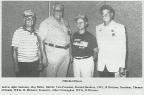
1985-86 Officers
Left to right: Secretary, Ray Miller, SKD1c;
Vice-President, Harold Dundore, CWT, B Division;
President, Thomas O'Grady, WT2c, B Division;
Treasurer, Albert Stranaghan, WT2c, B Division.
[picture]
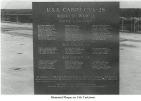
Memorial Plaque on USS Yorktown
~ 167 ~
Memories of the Cabot
Two years ago I had a thought
To see the shipmates with whom I'd fought
I called a few that night in the spring
And they said they'd come if I'd start this thing.
We left the East Coast in forty three
Our thoughts on what was yet to be
We operated with the fleet, knowing sooner or later
The Japs we would meet.
We sailed some with the Mighty Mo
That was almost forty years ago
We survived the typhoons in the blue Pacific
We dodged the torpedoes and that was terrific.
From the Marshall Islands to the Yellow Sea
Was many a mile
But when we headed back to Philly
We all had a smile.
We gather here from where we started
In 1946 we returned and then we parted
We have met former shipmates we didn't know
Although we were on the Cabot together years ago.
I dedicate this poem not only to all of us here
But to those former shipmates whose sacrifice is clear
Lets hope we will all meet again
But in case we don't, this final thought I wrote-
When the Master calls us to his Great Sea
Tell him you served on the Cabot-
And you'll be home free.
======================================================
O Cabot
O Cabot, great Cabot
Our days with you are done
The ship has weathered every storm
The victories we sought are won.
Because of you we have made friends
More valuable than gold
And as our lives do carry on
These memories we hold.
From coast to coast
You served us well
We're proud and even boast
Of memories we love to tell
When you served as our host.
We no longer see your smoking stacks
Or hear your engines running
But the memory lingers in our hearts
Because you were so cunning.
O Cabot, great Cabot
When the final bugle sounds
And we report to Captin's mast
With a heavy heart that pounds
We'll ask the admiral in the sky
To check the record of the ship
And that should make for all of us
A safe and happy trip.
Tom O'GRADY, President
USS CABOT ASSOCIATION
~ 168 ~
[picture]
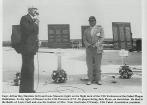
Capt. Arthur Ray Hawkins (left) and Gene Masucci (right) on the
flight deck of the USS Yorktown at the Cabot Plaque Dedication.
To the right of Masucci is the USS Princeton (CVL 23) plaque listing
Jack Flynn, an electrician. He died in the Battle of Leyte Gulf and
was the brother of Mrs. Tom (Gertrude) O'Grady, USS Cabot Association
president.
[picture]
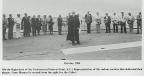
(On the flight deck of the Yorktown at Patriots Point, S.C.)
Representatives of the various carriers that dedicated their plaque.
Gene Masucci is second from the right for the Cabot.
~ 169 ~
[handwritten letter from Malcolm F. Schoeffel]
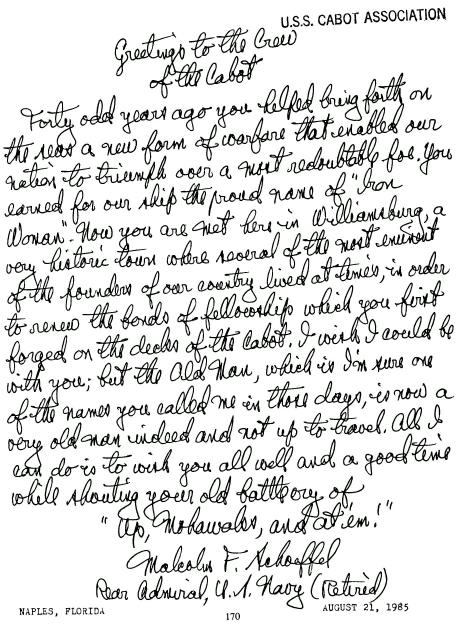
Greetings to the Crew
of the Cabot
Forty odd years ago you helped bring forth on
the seas a new form of warfare that enabled our
nation to triumph over a most redoubtable foe. You
earned for our ship the proud name of "Iron
Woman". Now you are met here in Williamsburg, a
very historic town where several of the most eminent
of the founders of our country lived at times, in order
to renew the bonds of fellowship which you first
forged on the decks of the Cabot. I wish I could be
with you; but the Old Man, which is I'm sure one
of the names you called me in those days, is now a
very old man indeed and not up to travel. All I
can do is to wish you all well and a good time
while shouting your old battlecry of
"Up, Mohawks, and at 'em!"
Malcolm F. Schoeffel
Rear Admiral, U.S. Navy (Retired)
Naples, Florida AUGUST 21, 1985
~ 170 ~
===================
.
BIBLIOGRAPHY
This book is based on the Deck Logs and the Action Reports of
the USS Cabot (CVL 28) from July 1943 to December 1945.
Other important sources were the Cruise Book of the Cabot
distributed by the Officer of Public Relations, Navy Department
and informal histories of Air Groups 29, 31, and 32.
REFERENCE BOOKS
Belote, James H and William H.,
Titans of the Sea: The Development of Japanese and American Carrier
Forces during World War II. 1975
Calhoon, Capt. C. Raymond,
The Other Enemy: The Third Fleet and the Pacific Storm of December
1944. Naval Institute Press, 1981
Forrestal, E. P.,
Admiral Raymond A. Spruance: A Study in Command.
U.S. Govt. Printing Office, 1966
Halsey, William F. and J. Bryan III.,
Admiral's Halsey's Story. Curtis Publishing Co., 1947
Hoyt, Edwin P.,
The Battle of Leyte Gulf: The Death Knell of the Japanese Fleet.
Webright and Talley, 1972
Karig, Walter et Al.,
Volume IV End of an Empire Volume V, Victory in the Pacific.
Rinehart and Co. 1948-1949
Clark, J. J. and Reynolds, Clark G.,
Carrier Admiral. David McKay Co, 1967
Conway's All the World's Fighting Ships. 1922-46,
U.S. Naval Institute Press, 1980
Costello, John,
The Pacific War. Rawson, Wade Publishers, 1981
Naval History Division (Department of the Navy)
Dictionary of American Naval Fighting Ships,
Volumes I-VIII
Manchester, William R.,
American Caesar: Douglas MacArthur. Little, Brown Boston, 1978
Monsarrat, John,
Angel on the Yardarm: The Beginnings of Fleet Radar Defense
and the Kamikaze Threat. Naval War College, 1985
Moore, Capt. John,
Jane's Fighting Ships 1981-82. Naval Institute Press, 1980
Morison, Samuel E.,
History of U.S. Naval Operations in World War II,
Little and Brown Co.
Volume VII, Aleutians, Gilberts, and Marshalls, 1951
Volume XII, Leyte, 1958
Volume XIII, The Liberation of the Philippines, 1959
Volume XIV, Viclory in the Pacific, 1960
Volume XV, Supplement and General Index
Pawlowski, Gareth L.,
Flat-tops and Fledglings: A History of American Aircraft Carriers.
Castlebooks, 1971
Potter, E. B.,
Nimitz. Naval Institute Press, 1976
Potter, E. B.,
Bull Halsey. Naval Institute Press, 1985
Pyle, Ernie,
Last Chapter. Henry Holt and Co., 1946
Reynolds, Clark G.,
The Fast Carriers: The Forging of an Air Navy. McGraw, Hill Co., 1968
Sherman, Fredrick C.,
Combat Command: The American Aircraft Carrier in the Pacific War.
E. P. Dutton & Co., 1950
Saburo Sakai w/ Martin Caiden,
Samurai. Dutton, 1957
Taylor, Theodore,
The Magnificent Mitscher. Norton, 1954
~ 171 ~
Terzibaschitsch, Stefan,
Aircraft Carriers of the U.S. Navy. Naval Institute Press, 1978
Winston, Robert A.,
Fighting Squadron: A Fighter Pilot's First Hand Account.
Zenger Publishing, 1946
Warner, Denis and Warner, Peggy,
The Sacred Warriers. VanNostrand Reinhold Co., 1982
King, Fleet Admiral E. J.,
U.S. Navy At War. U.S. Government Printing Office 1946
Y'Blood, William T.,
Red Sun Setting: The Battle of the Philippine Sea, 1981
Spurr, Russell,
A Glorious Way to Die. Newmarket Press, 1981
The Bluejacket 's Manual. U . S . Naval Institute, 1944
MAGAZINES:
Proceedings. U.S. Naval Institute (various issues)
Tailhook
U. S. Naval Magazine - All Hands
~ 172 ~
=====================
Click here for Association Members list Errata, picture of author on the endflap, and photo of Cabot as DeDalo - from back cover.
Return to Table of Contents


